Sunday, February 04, 2018

Mud Cake : Poor Haitians Resort to Eating Dirt Mud Cakes Recipe


A woman prepares mud cakes at the Cite-Soleil neighborhood, in Port-au-Prince, Haiti. Some people eat mud cookies made of dirt, butter and salt to fill their stomachs.

At first sight the business resembles a thriving pottery. In a dusty courtyard women mould clay and water into hundreds of little platters and lay them out to harden under the Caribbean sun.

The craftsmanship is rough and the finished products are uneven. But customers do not object. This is Cité Soleil, Haiti's most notorious slum, and these platters are not to hold food. They are food.

Brittle and gritty - and as revolting as they sound - these are "mud cakes". For years they have been consumed by impoverished pregnant women seeking calcium, a risky and medically unproven supplement, but now the cakes have become a staple for entire families.

It is not for the taste and nutrition - smidgins of salt and margarine do not disguise what is essentially dirt, and the Guardian can testify that the aftertaste lingers - but because they are the cheapest and increasingly only way to fill bellies.

"It stops the hunger," said Marie-Carmelle Baptiste, 35, a producer, eyeing up her stock laid out in rows. She did not embroider their appeal. "You eat them when you have to."

These days many people have to. The global food and fuel crisis has hit Haiti harder than perhaps any other country, pushing a population mired in extreme poverty towards starvation and revolt. Hunger burns are called "swallowing Clorox", a brand of bleach.

The UN's Food and Agriculture Organisation predicts Haiti's food import bill will leap 80% this year, the fastest in the world. Food riots toppled the prime minister and left five dead in April. Emergency subsidies curbed prices and bought calm but the cash-strapped government is gradually lifting them. Fresh unrest is expected.

According to the UN, two-thirds of Haitians live on less than 50p a day and half are undernourished. "Food is available but people cannot afford to buy it. If the situation gets worse we could have starvation in the next six to 12 months," said Prospery Raymond, country director of the UK-based aid agency Christian Aid.

Until recently this Caribbean nation, which vies with Afghanistan for appalling human development statistics, had been showing signs of recovery: political stability, new roads and infrastructure, less gang warfare. "We had been going in the right direction and this crisis threatens that," said Eloune Doreus, the vice-president of parliament.

As desperation rises so does production of mud cakes, an unofficial misery index. Now even bakers are struggling. Trucked in from a clay-rich area outside the capital, Port-au-Prince, the mud is costlier but cakes still sell for 1.3p each, about the only item immune from inflation. "We need to raise our prices but it's their last resort and people won't tolerate it," lamented Baptiste, the Cité Soleil baker.

Vendors of other foods who have increased prices have been left with unsold stock. In the Policard slum, a jumble of broken concrete clinging to a mountainside, the Ducasse family tripled the price of its fritters because of surging flour prices. "Our sales have fallen by half," said Jean Ducasse, 49, poking at his tray of shrivelled wares.

The signs of crisis are everywhere. Aid agency feeding centres reported that the numbers seeking help have tripled. At a centre in the Fort Mercredi slum rail-thin women cradled infants with yellowing hair, a symptom of malnutrition. "Now we're having to feed the mothers as well as the babies," said Antonine Saint-Quitte, a nurse.

In rural areas the situation seems even worse, prompting a continued drift to the slums and their mirage of opportunities. Lillian Guerrick, 56, a subsistence farmer near Cap Haitien, yanked her seven grandchildren from school because there was barely money for food let alone fees. "I've no choice," she said, a touch defensive, amid wizened corn stalks.

Anecdotal evidence suggests school attendance nationwide has dropped and that those who do make it to class are sometimes too hungry to concentrate. "I use jokes to try to stimulate my students, to wake them up," said Smirnoff Eugene, 25, a Port-au-Prince teacher.

Border crossings to the Dominican Republic are jammed with throngs of merchants hunting lower prices in their relatively prosperous neighbour.

"Beep beep, out of the way!" yelled one teenage boy, sweating, veins throbbing, as he heaved a wheelbarrow impossibly overloaded with onions through a crowd at Ouanaminthe's border bridge.

Haiti's woes stem from global economic trends of higher oil and food prices, plus reduced remittances from migrant relatives affected by the US downturn. What makes the country especially vulnerable, however, is its almost total reliance on food imports.

Domestic agriculture is a disaster. The slashing and burning of forests for farming and charcoal has degraded the soil and chronic under-investment has rendered rural infrastructure at best rickety, at worst non-existent.

The woes were compounded by a decision in the 1980s to lift tariffs, when international prices were lower, and flood the country with cheap imported rice and vegetables. Consumers gained and the IMF applauded but domestic farmers went bankrupt and the Artibonite valley, the country's breadbasket, atrophied.

Now that imports are rocketing in price the government has vowed to rebuild the withered agriculture but that is a herculean task given scant resources, degraded soil and land ownership disputes.

There is a hopeful precedent. A growing franchise of localised dairies known as Let Agogo (Creole for Unlimited Milk) has organised small farmers to transport and market milk, generating jobs and income and cutting Haiti's £20m annual milk import bill.

President René Préval has hailed the scheme as a model but Michel Chancy, a driving force of Veterimed, a non-governmental organisation which backs the dairies, was wary. "For 20 years politicians have been talking about reviving agriculture but didn't actually do anything. If this food crisis forces them to act then it is a big opportunity." That was a big if, he said.

Walk along a beach in the morning and you find Haitians gazing at the azure ocean horizon, dreaming of escape. They are fiercely proud of their history in overthrowing slavery and colonialism but these days the US, the Bahamas, the Dominican Republic - anywhere but home - seems the best option.

The only thing stopping an exodus are US coastguard patrols, said Herman Janvier, 30, a fishermen on Cap Haitian, a smuggling point. "People want out of here. It's like we're almost dead people."

The last time Janvier tried to flee he was intercepted and interned at Guantánamo Bay. "I offered to join the American army. I offered to clean their base. They said no. So I am back here, on a boat with no motor, doing what I can to survive."




Saturday, February 03, 2018

Feline Fanatic Collects Thousands of Ceramic Cats | Wired Collection

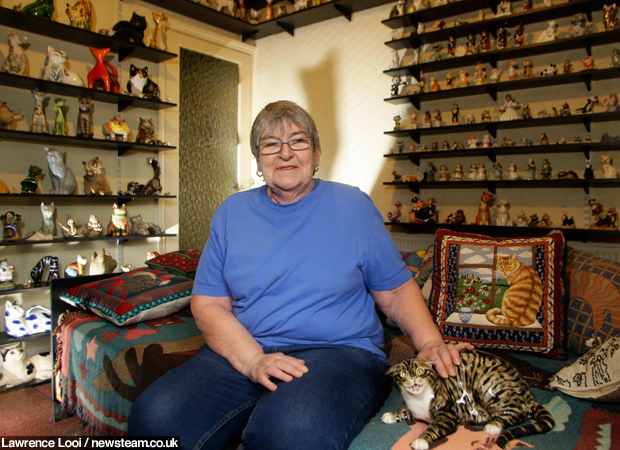
A feline fanatic has spent the last 60 years amassing a bizarre collection of over 2,000 ceramic cats… and she won't stop until it's purr-fect.

Pamela Cole, 60, from Birmingham, has been collecting the cats since the late 1940s, after her mother gave her a replica of a beloved kitten.

The collection, thought to be worth over £50,000, contains ornaments worth anything from 10p to over £1,000 and she even has one cat dating back to 600BC.

Pam, who now has a staggering 2,222 cats of varying shapes and sizes, says she keeps them in her spare bedroom and has stopped anyone sleeping in there.

But despite already being short of space to display them, she said she can't wait to get her paws on more.

Speaking of her collection Pamela said: "I really do have them from all over the world, and I've bought them in china shops, toy shops, antiques shops, at craft fairs, antiques fairs and on eBay.

"I try to get them as different as possible, and I have them from every continent."

Friday, February 02, 2018

Villa Escudero Resort with the Waterfalls Restaurant in Philippines

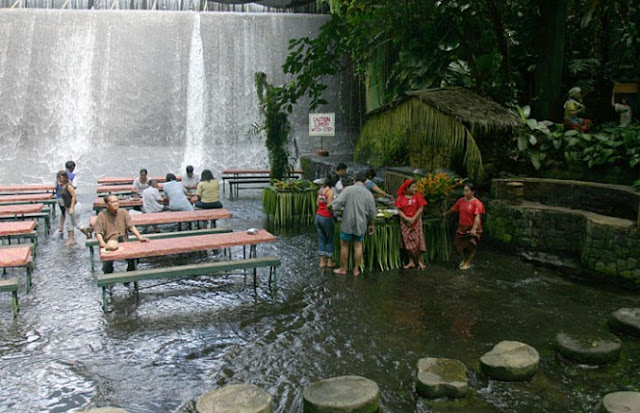
Villa Escudero Resort is located in Quezon Province, Philippines, offering a vast hacienda filled with comfortable rooms, and a museum of curious things. Perhaps the most curious thing at the villa is the amazing Waterfalls Restaurant, where lunch is served against an impressive backdrop of thundering clear spring water. Grass fringed buffet stations and bamboo dining tables stand steadily in just inches of flowing river water from the sparkling falls, as it washes around the feet of diners enjoying delicious local dishes.

The experience of dining as water is running over your feet would certainly create a memorable holiday moment, and possibly one of your most unusual experiences ever, as they boast this “is a truly singular and memorable experience only Villa Escudero can offer.”

Villa Escudero Plantations is 800 hectares (2,000 acres) of working coconut plantation and hacienda located 10 kilometres (6.2 mi) south of the city of San Pablo, Laguna province on the border with Quezon province.Since 1981, the plantation has opened its doors as a resort offering village tours, museum tour, food and accommodations. It has developed a worldwide reputation as a focal point to experience Philippine culture and history in a beautiful rural setting.

The plantation encompasses three municipalities in two provinces: San Pablo City in Laguna and the towns of Tiaong, and Dolores in Quezon province. The entrance to the resort is located just a few feet from the Laguna/Quezon boundary arch.

Villa Escudero Plantations was founded in 1872 by Don Placido Escudero and his wife Doña Claudia Marasigan. Originally planted to sugar cane, the crop was converted to coconut by their son Don Arsenio Escudero in the early 1900s. A pioneering agriculture industrialist, he built the country’s first working hydroelectric plant - Labasin Dam - to supply his desiccated coconut factory and the Escudero Plantation house, which he and his wife Doña Rosario Adap built in 1929.

The plantation was opened to the public in 1981 as a tourist attraction, offering glimpses of plantation life. The family's eclectic private collection was presented as a Museum tour. Carabao cart ride takes visitors to the resort area, surrounded by park-like setting while being serenaded by locals. Dining is offered in a unique al fresco restaurant where the dining tables are situated below the spillway of the hydroelectric dam (or the 'Labasin waterfalls') while diners enjoy their lunch dipped in the flowing calf-deep water. Later attractions include an authentic live cultural dance show choreographed by National Artist Ramon Obusan, performed with live music. The resort has since expanded offering accommodations, more restaurants, sports facilities, and a conference center.

In 2008, 415 hectares (1,030 acres), more than half of the estate, was converted into an exclusive residential development called Hacienda Escudero.

Villa Escudero Resort
Villa Escudero Resort with the Waterfalls Restaurant in Philippines


Villa Escudero Resort
Villa Escudero is equally nature bathed, with stunning views from bamboo decks overlooking the still waterscape of Lake Labasin, and the tropical Philippine countryside.


Villa Escudero Resort
Filipino Restaurant at the Foot of a Waterfall


Villa Escudero Resort
Best Batangas Resorts & Hotel


Villa Escudero Resort
Villa escudero


Villa Escudero Resort
Incredible Waterfall Restaurant at the Villa Escudero


Villa Escudero Resort
Waterfall Restaurant

Thursday, February 01, 2018

The World's Top Most Expensive And Luxury Bed Goes On Sale

A handcrafted double bed has gone on sale for £4 million and is touted as the world’s most expensive place to rest your head.

The Baldacchino Supreme is inlaid with 107kg (236lb) of 24ct gold and is fashioned out of chestnut and ash wood with a cherry wood canopy.

It comes complete with Italian silk and cotton drapes and the headboard can be customised to take diamonds for that hint of extra bling.

The luxury item was made by British designer Stuart Hughes, who specialises in dolling up items for the super rich, such as gold-plating iPhones and selling them for £22,000.

He also hit the headlines when he customised an iPhone 4 with a 65million-year-old T.rex tooth and meteoric stone.

The 39-year-old Liverpudlian, who worked with Italian design company Hebanon for the bed, said the ‘incredible’ detail made it ‘out of this world’.

‘It is the sort of thing only the super rich can afford, billionaires who have everything and are always looking for unique gifts,’ he added.

He has made two of the beds so far, with each one taking three months.

One has already been snapped up by an Italian businessman.

Wednesday, January 31, 2018

Hotel for Chicken Opens Up in Cornwall


I’ve read and written about a some pretty unusual hotels, in the past, but this is the first chicken hotel I’ve ever heard of.

The Chicken Hotel created by 31-year-old David Roberts, from Boskenwyn, Helston, is almost just like any other hotel out there, with one big difference – instead of people, it offers accommodations for chicken. I know it sounds like a joke, but this place is for real, and apparently it’s also very successful.

“With more people looking to escape the rat race and move out in the country with a little bit of land, keeping chickens is becoming more and more popular. But what do you do if you go away on holiday? Who looks after the chicken?” asks Mr. Roberts, who opened his unusual establishment to encourage people to raise their own chicken. A former cabinet-maker, David Roberts built the chicken coops himself and now rents them for 2 pounds each, plus 75 pence per chicken.

Each coop in the Chicken Hotel holds up to eight chicken and the current offer includes buffet breakfast, lunch and dinner of local produce, served in open-air. Guests are allowed to roam around the hotel grounds all day, before being gathered to roost at night. According to Mr. Roberts, the hotel was fully booked over Christmas time, and he hopes half term and Easter will be just as successful.


Source :- Oddity Central